
Article updated on May 25, 2026 — amounts confirmed as of January 1, 2026 (CNSA, ANAH, URSSAF).
To help finance home care for an elderly relative in 2026, there are five main programs available that can be combined: the APA (Personalized Autonomy Allowance), MaPrimeAdapt’ for home modifications, the tax credit for in-home employment, CARSAT assistance, and the CESU. According to a Skarlett survey (2025), nearly 40% of seniors do not take advantage of the assistance to which they are entitled, either due to a lack of information or because they are afraid of the administrative process.
This guide provides details on each program, including the amounts, eligibility requirements, and rules for combining benefits.
Key takeaways:
- 5 main programs that can be combined (APA, MaPrimeAdapt’, tax credit, CARSAT, CESU)
- APA: up to €2,080/month (GIR 1), no means test
- MaPrimeAdapt’: up to 70% of the cost of home modifications, capped at €22,000 (excluding tax)
- Tax credit: 50% of home care expenses, capped at €12,000 per year
- APA processing time: up to 2 months after the application is complete
At a glance: The 5 grants that can be combined in 2026
| Device | Who is funding it? | What for? | Can be combined with |
| APA (GIR 1–4) | Departmental Council | Home care hours, telecare | Tax credit (out-of-pocket expenses), CESU, health insurance |
| MaPrimeAdapt’ | ANAH | Home Renovation Work | CARSAT, mutual insurance, APA (separate expenses) |
| Tax Credit for Services | Status | Work from home (caregiver or care recipient) | APA (out-of-pocket costs), CESU, health insurance |
| Prepaid CESU | Employer, Works Council, CARSAT, health insurance provider, Departmental Council | Home care services (including at a relative's home) | APA, tax credit, health insurance |
| CARSAT | Pension Fund | GIR 5-6, Discharge from the Hospital | APA, tax credit, health insurance |
| Health Insurance | Private insurer | Equipment, telecare, CESU | All public facilities |
What You Need to Know Before You Begin
Who is eligible?
Home care assistance is primarily intended for people aged 60 and older who have lost their independence or wish to plan ahead. Some—such as the APA—are contingent on an assessed level of dependency (GIR 1 to 4). Others—such as the tax credit for in-home employment—are available to everyone, regardless of income or level of independence.
How these benefits are combined
Most of these benefits can be combined, provided that the same expenses are not covered twice. The APA covers the cost of home care hours; the tax credit applies to the portion you are responsible for after the APA, not to the total amount.
The APA — the cornerstone of financial aid
The APA (Personalized Autonomy Allowance) is the primary form of financial assistance for people with reduced independence. It is paid by the Departmental Council and directly funds home care services, telecare, or certain assistive devices.
2026 Amounts by GIR Level
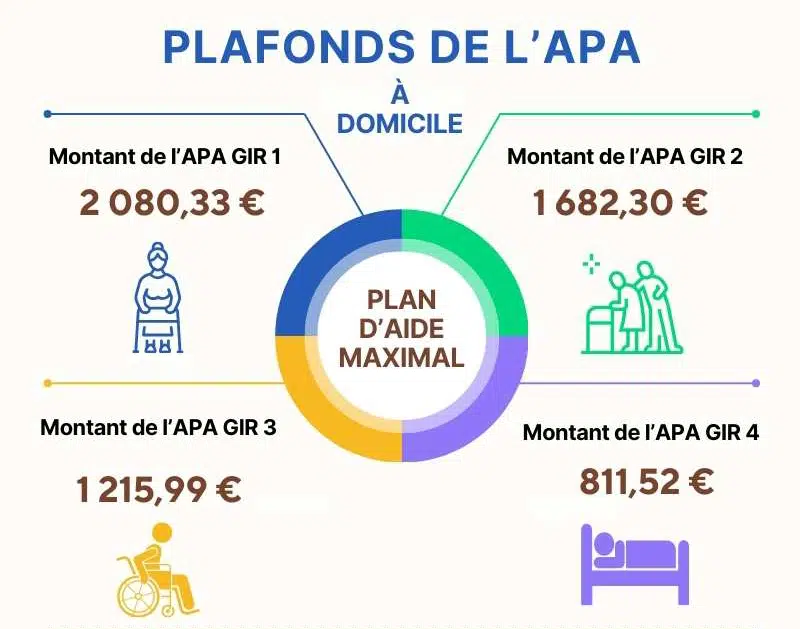
The monthly limit for the assistance program varies depending on the level of dependency as assessed by the AGGIR scale (source: CNSA, cnsa.fr, revised as of January 1, 2026):
- GIR 1 (total dependency): €2,080/month
- GIR 2 (severe dependency): €1,682/month
- GIR 3 (partial dependency): €1,216/month
- GIR 4 (moderate dependency): €811.52/month
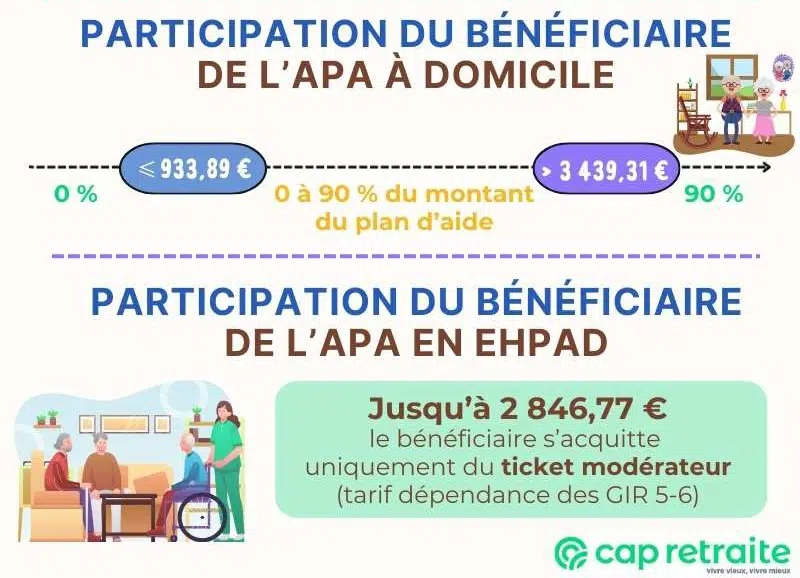
The APA is not means-tested. A sliding-scale contribution is required for incomes above €933.89 per month, and can reach 90% of the assistance amount for incomes exceeding €3,439.31 per month.
How to apply
Applications must be submitted to the Departmental Council (Cerfa form no. 16301*01). The department has two months to notify the applicant of its decision. In urgent cases, an emergency APA can be accessed immediately—the amount is equal to half of the maximum allowance granted for GIR 1.
MaPrimeAdapt’ — Funding Home Modifications
MaPrimeAdapt’ is the ANAH program designed to fund home accessibility modifications. Launched in January 2024, it replaced several previous programs.
Eligibility Requirements
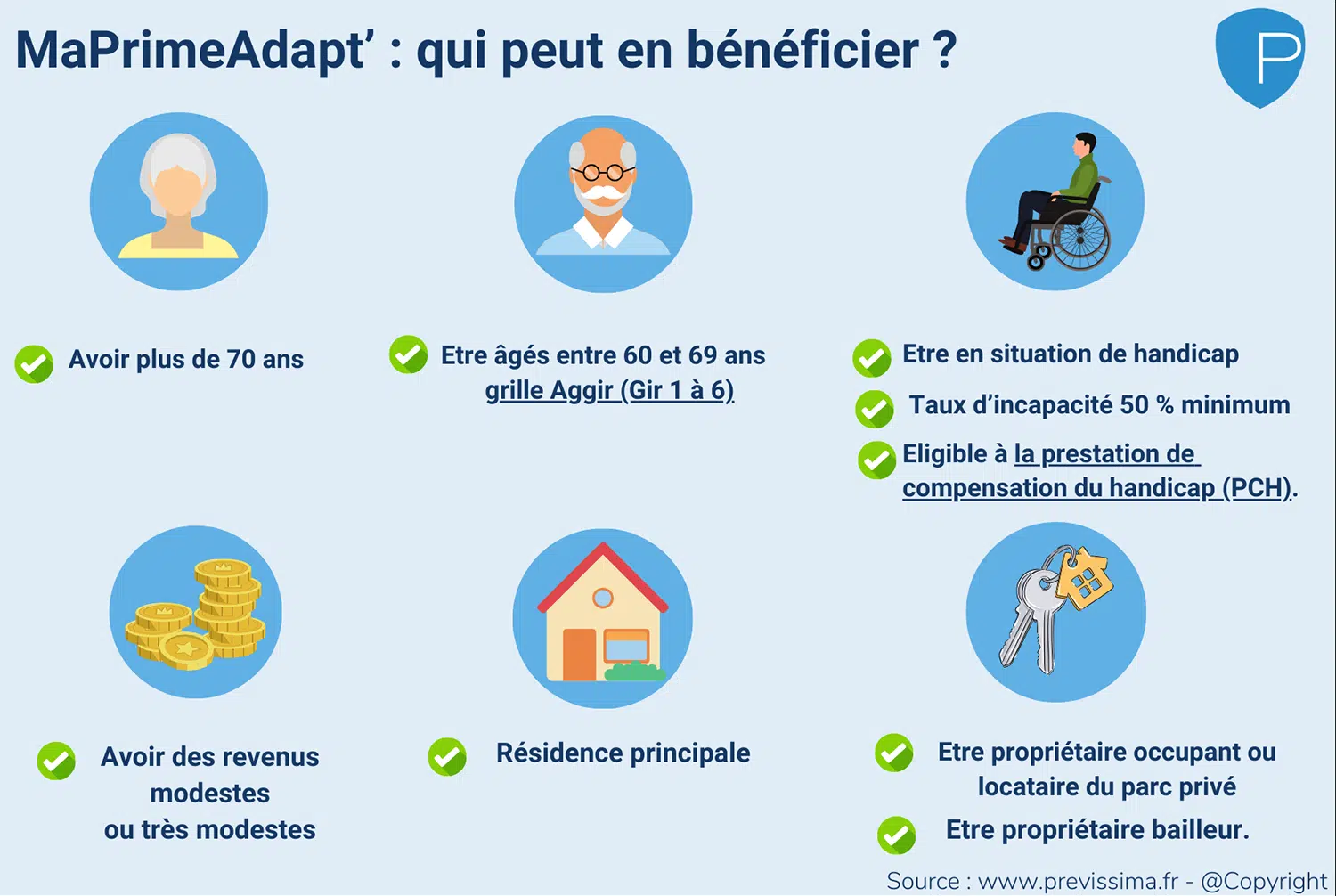
- Be 70 years of age or older, or between 60 and 69 years of age with a documented loss of independence (GIR 1–6), or under 60 years of age with a recognized disability (disability rating ≥ 50%)
- Be a homeowner or a tenant with the landlord's written consent
- Have lived in the home as a primary residence for more than 15 years
- Having a modest or very modest income according to ANAH guidelines
Covered amounts and work
- Households with very low incomes: 70% of the cost of the work is covered, up to €22,000 (excluding tax) over 5 years
- Low-income households: 50% of the cost of the work is covered, up to the same limit
Eligible projects: replacing a bathtub with a walk-in shower, installing a stairlift, widening doorways, installing grab bars, raising toilet seats, and home automation. Your Autonomia Advisor can refer you to an ANAH-approved project management consultant and connect you with qualified home modification specialists, Silver Alliance partners, or vetted local contractors.
Focus Area 2026 — MaPrimeAdapt’
|
After being suspended at the end of 2025, the MaPrimeAdapt’ program reopened on February 23, 2026, following the enactment of the 2026 Finance Act. Eligibility requirements and funding rates remain unchanged. The review of applications submitted at the end of 2025 has resumed. Processing times may be longer during the first few months. Never begin work without written approval from Anah. (Source: anah.gouv.fr, press release dated February 20, 2026.) |
The tax credit for domestic workers
50% of expenses — up to €6,000 in credit
The program covers 50% of expenses incurred for in-home services, up to a limit of €12,000 per year, for a maximum credit of €6,000. This limit is increased by €1,500 per household member over the age of 65 and may reach €20,000 for a disabled or dependent person (source: Article 199 sexdecies of the General Tax Code).
The caregiver can also benefit from this
If you pay for in-home care services for your parent, you can deduct 50% of those expenses from your own taxes—provided your parent receives the APA (source: service-public.fr). This credit cannot be combined with the deduction for alimony paid to the same parent.
The immediate benefit: pay only 50% upon receipt of the invoice
Since 2022, the CESU+ service (which can be activated at cesu.urssaf.fr) allows you to pay only half of the cost of home care services up front—the government covers the remaining 50% directly.
Important — Update for 2026
|
Equipment tax credit (25%): ELIMINATED for expenses paid on or after January 1, 2026. For home modifications in 2026: MaPrimeAdapt’ is the program to use. Source: service-public.fr, article F10752. |
The CESU — Simplifying Payments and Encouraging Employer Support
The CESU declaration system: for individual employers
When a family hires a home care worker directly, the CESU reporting system handles all the necessary paperwork on cesu.urssaf.fr: reporting of hours worked, automatic calculation of social security contributions, and issuance of pay stubs.

The Pre-funded CESU: An Underutilized Tool for Employees Who Care for Others
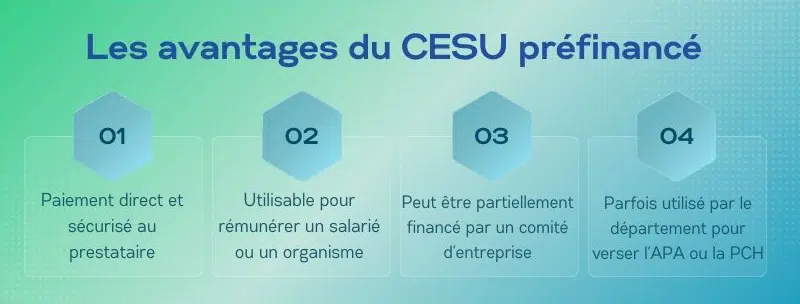
The pre-funded CESU is a payment voucher co-financed by the employer, the Social and Economic Committee (CSE), the pension fund, the mutual insurance company, or the Departmental Council. The URSSAF exemption limit will reach €2,591 per beneficiary per year in 2026 (source: URSSAF, decree of December 23, 2025).
Key point: Prepaid CESU vouchers can be used to pay for in-home services provided to a relative who receives APA benefits. In 33 departments, the APA itself is paid out in the form of prepaid CESU vouchers.
CARSAT Benefits
CARSAT offers home care assistance for retirees under the general social security system, which is separate from and complementary to the APA.
Who is it for?
CARSAT assistance is primarily intended for individuals classified as GIR 5 and 6—who are not eligible for APA—and retirees under the general pension scheme who have recently been discharged from the hospital.
What they cover
Two main programs: means-tested in-home care, and ARDH (Assistance for Returning Home After Hospitalization), which can be arranged within a few days of being discharged from the hospital.
Benefits from supplemental health insurance
The scope varies by policy but often includes: telecare, hearing aids, mobility aids, and sometimes hours of home care or night care. Some senior policies offer pre-funded CESU vouchers. Ask for details on the “independence” or “long-term care” coverage included in your policy.
Why work with an Autonomia Advisor to navigate these financial aid options
Five programs, five application windows, complex rules regarding eligibility for multiple benefits, and varying processing times. According to Skarlett (2025), nearly 40% of seniors do not take advantage of the assistance to which they are entitled, either due to a lack of information or because they are afraid of the application process.
An Autonomia Advisor—a medical-social professional and expert in APA, MDPH, and pension fund and mutual insurance assistance programs—will verify your loved one’s eligibility, determine the correct sequence of steps, compile the necessary documentation, and actively secure the benefits.
You save the equivalent of several weeks of research and administrative follow-ups, and you maximize the amount of assistance actually received.
Steps to take in order
- Assess your loved one's GIR level (free application available from the Departmental Council)
- Submit the APA application as soon as the GIR is known (Cerfa form no. 16301*01)
- Contact CARSAT if your loved one is being discharged from the hospital or is in GIR 5-6
- Check the "long-term care" coverage in your loved one's health insurance policy
- For home modification projects: contact an ANAH-certified project manager (0 808 800 700 — toll-free) and check whether the MaPrimeAdapt’ application portal is open on anah.fr
- Report all domestic help employment through the CESU reporting system (cesu.urssaf.fr) to claim the 50% tax credit
FAQ
What financial assistance is available to help people remain in their homes in 2026?
In 2026, five main programs can be combined. The APA covers the cost of home care hours for GIR 1 through 4—up to €2,080 per month for a GIR 1. MaPrimeAdapt’ covers up to 70% of home modification costs, up to a limit of €22,000 (excluding tax). The tax credit for in-home employment covers 50% of expenses, capped at €12,000 per year—available to all households. CARSAT assistance supplements the APA for retirees under the general pension scheme. The pre-funded CESU (up to €2,591/year in 2026) allows the employer or health insurance provider to co-fund home care services.
What will the APA amount be in 2026?
The maximum monthly amount of the APA home care allowance in 2026 varies according to the GIR level: €2,080 for GIR 1, €1,682 for GIR 2, €1,216 for GIR 3, and €811.52 for GIR 4 (source: CNSA, rates as of January 1, 2026). The APA is not means-tested, but a sliding-scale contribution is required for incomes exceeding €933.89 per month.
Can the APA and the tax credit be combined in 2026?
Yes, but the tax credit applies only to the portion of the expenses you are responsible for after the APA has been deducted. If your home care expenses total €600 per month and the APA covers €400, the tax credit applies to the remaining €200.
How will MaPrimeAdapt’ work in 2026?
MaPrimeAdapt’ is the ANAH’s sole program for financing home modifications to accommodate aging or disability. It covers up to 70% of the cost of the work for very low-income households (50% for low-income households), up to a limit of €22,000 (excluding tax) over 5 years.
Main eligibility requirements: be 70 years of age or older (or 60–69 years of age with a loss of independence classified as GIR 1–6), and have occupied the home as a primary residence for more than 15 years.
Is a tenant eligible for MaPrimeAdapt’?
Yes, under certain conditions. The tenant must obtain the landlord’s written consent before submitting the application and must have occupied the dwelling as their primary residence for more than 15 years.
My parent is 85 years old and receives a small pension. What financial assistance are they eligible for?
Three types of assistance to prioritize: the APA (Allocation for Autonomy) if a loss of autonomy is confirmed (GIR 1–4), CARSAT assistance for retirees under the general pension scheme (home help, ARDH after hospitalization), and the tax credit for in-home employment (50% of expenses). Pre-funded CESU vouchers can supplement this assistance if your supplemental health insurance plan offers them.
As a child who provides care, can I claim a tax deduction for the services I pay for on behalf of my parent?
Yes, provided that your parent receives the APA. The tax credit applies to the home of an ascendant who is an APA recipient (source: service-public.fr). Please note: this credit cannot be combined with the deduction for child support for the same parent.
What should I do if my parent is in GIR 5 or 6—and therefore ineligible for APA?
Three complementary options: assistance from CARSAT (home help, post-hospitalization home care), municipal or departmental assistance, and the tax credit for in-home employment (50% of expenses).
Are home care assistance payments recoverable from the estate?
The APA is not recoverable from the beneficiary’s estate (source: CNSA, cnsa.fr). However, certain departmental or municipal benefits may be subject to recovery.
Sources
- CNSA, APA amounts for 2026 (cnsa.fr)
- ANAH, MaPrimeAdapt’ (anah.fr)
- URSSAF, 2026 Pre-financed CESU Limit, Order of December 23, 2025 (urssaf.fr)
- Article 199 sexdecies of the General Tax Code (legifrance.gouv.fr)
- service-public.fr (records F10752, F31106)
- Skarlett, 2025 Survey on the Underutilization of Assistance Programs
- Social Action and Family Code, Sections L232-3 et seq.