
Article updated on May 11, 2026 — verified official sources (INRS, URSSAF, Malakoff Humanis, France Travail).
ROI of the Paid Caregiver Program: How to Justify the Investment to Your Executive Committee
To make a case for investing in a caregiver support program to your executive committee, you’ll need three types of arguments: the cost of inaction, which can be quantified in terms of your current payroll; documented return on investment from occupational health prevention; and credible post-deployment performance metrics for your CFO.
This article organizes these three arguments using the available data, highlights gaps in the literature, and proposes a method that can be applied to your context right from the first reading.
Three key ratios to remember:
- A return of €2 to €5 for every euro invested in occupational health prevention (INRS 2024)
- €448,680 per year: estimated cost of inaction for 500 employees (Malakoff Humanis + INRS 2024)
- €2,591 per beneficiary per year: URSSAF exemption for the pre-funded CESU in 2026
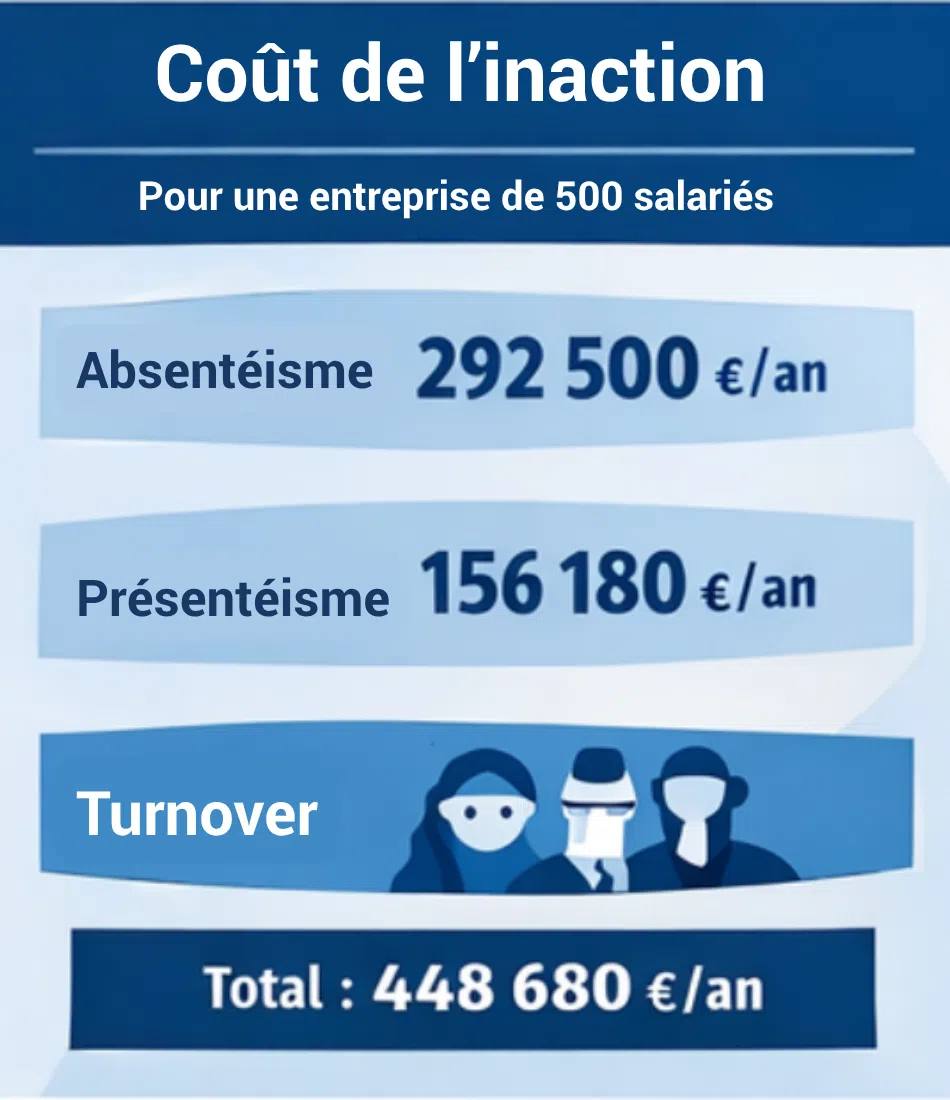
Quantifying the Cost of Inaction
Before justifying an investment, you have to consider the cost of doing nothing. It is this argument that convinces the CFO—not the social aspect of the issue.
Absenteeism: The Visible Side
An absent employee costs their employer an average of €4,500 per year, of which only 20% are direct costs (continued pay, social security contributions) and 80% are indirect costs—replacement, reorganization, loss of skills, and impact on teams (source: Malakoff Humanis 2024).
The absenteeism rate in the private sector reached 5.1% in 2024, up 3% (source: WTW 2025). Among employees on sick leave in 2024, 51% were family caregivers (source: Malakoff Humanis 2025).
Presenteeism: The Invisible and More Costly Problem
Presenteeism is systematically omitted from HR dashboards. Its cost is estimated at €2,740 per year per affected employee (source: Malakoff Humanis 2024).
57% of employees who are caregivers report facing difficulties (source: Occurrence/La Mutuelle Générale Survey, 2023). Out of 100 employees who are caregivers in a company with 500 employees: 57 × €2,740 = €156,180/year in estimated presenteeism costs.
Employee turnover: a cost that is difficult to isolate, but can be documented
One-third of employees who are caregivers report working longer hours to compensate for a drop in productivity they themselves perceive—without their employer being aware of it (source: OCIRP, 2023). The cost of replacement ranges from 50% to 200% of gross annual salary, depending on the employee’s profile (INRS/Malakoff Humanis range, 2024).
Summary Table — Cost of Inaction (based on 500 employees)
Position | Hypothesis | Annual estimate |
Employees who are caregivers | 100 (20% of 500) | — |
Absenteeism (65% of 100) | 65 × €4,500 | 292 500 € |
Presenteeism (57% of 100) | 57 × €2,740 | 156 180 € |
Partial turnover | To be calculated internally | Not included here |
Estimated total (excluding turnover) | €448,680 per year |
Method: Average private sector data (sources: Malakoff Humanis 2024, INRS 2024). Refine using internal figures for an executive committee presentation. This table is designed to be included as-is in a presentation.
The cost of a program for paid caregivers
The components of a program
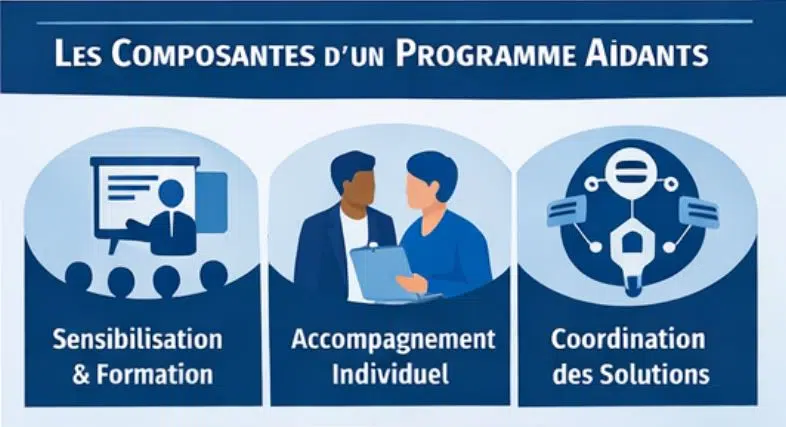
A structured caregiver program typically includes three levels of service:
Awareness and identification: internal communication, training managers to recognize early warning signs, and an anonymous reporting system.
Personalized support: dedicated advisor, assessment of your situation, guidance toward solutions.
Coordination of service providers: implementation of practical solutions—home care, telecare, home modifications, SSIAD, SAAD. The Autonomia Advisor relies on a three-pronged ecosystem: the Oui Care network (900+ agencies throughout France, including rural areas), Silver Alliance (partners in healthy aging), and audited local service providers.
A single point of contact to coordinate everything.
Calculating ROI — Method and Figures
The benchmark ratio: €2 to €5 for every €1 invested
Every euro invested in occupational health and safety yields a return on investment of between 2 and 5 euros (source: INRS, 2024). This ratio serves as the baseline for the ROI case presented to the executive committee.
How to Present ROI to the Executive Committee
Template to include in your executive committee slide:
Slide 1 — The cost of inaction [custom figure] €/year not accounted for in the payroll
Slide 2 — The sector-specific return on investment ratio of €2 to €5 for every €1 invested (INRS 2024) — applicable to psychosocial risk prevention and occupational health
Slide 3 — Minimum net benefit [cost of inaction] − [program cost] = [annual net benefit]
Slide 4 — Proposed monitoring KPIs: Utilization rate, absenteeism, NPS of caregivers supported, retention rate
Arguments by speaker
For the CFO: reducing an existing cost
The key point isn’t “investing in well-being”—it’s “reducing a cost that’s already weighing on your payroll and that you don’t see.” The cost of inaction (between €400,000 and €600,000 per year for 500 employees) is higher than the cost of a structured program. It’s a management decision, not a social expense.
For the CEO: A matter of employer branding and responsibility
The demographic inevitability: By 2030, 1 in 4 employees will be a caregiver (source: France Travail, 2024). Failing to plan ahead means having to react in five years to a workforce that is twice as vulnerable.
Employer brand: Candidates aged 30–40 factor in support policies for caregivers when evaluating an employer, just as they do when considering parental leave.
For the HR director: a growing concern regarding QVCT compliance
Mandatory negotiations on QVCT provide the regulatory framework within which caregiving can be recognized as a psychosocial risk. Several industry sectors have begun to incorporate specific provisions into their sector-wide agreements.
Post-deployment monitoring indicators
Indicator | Frequency | Source |
Program utilization rate | Quarterly | Program operator |
Absenteeism — identified employees who are caregivers | Semiannual | Internal HR |
NPS for employees who are caregivers | Annual | Internal investigation |
Retention rate — employees who are caregivers | Annual | Internal HR |
Total program cost vs. estimated savings | Annual | Chief Financial Officer + Operator |
Note: Absenteeism KPIs can only be measured if employees who are caregivers are identified through a voluntary reporting system.
Items to prepare for your executive committee presentation
- Customized calculation of the cost of inaction: internal absenteeism rate × estimated proportion attributable to caregiving × average cost per absence
- Estimated number of employees who are caregivers in your workforce (demographic analysis + QWL survey, if available)
- Program cost estimate: Contact Autonomia for a quote based on your project scope
- ROI Table: Cost of Inaction vs. Program Cost vs. INRS Ratio of 2:1
- Proposed KPIs with reporting frequency — to be included in the Executive Committee resolution
- Industry benchmark: 3 to 5 leading companies in your industry that have implemented a caregiver support program (available from Autonomia)
- Legal Argument QVCT: Check whether your industry-wide agreement mentions assistance
How can you calculate the ROI of an employee caregiver program without internal data on caregiving?
The method consists of two steps. First, estimate the cost of inaction using a demographic approximation: 20% of your workforce × average absenteeism cost (€4,500) × percentage of employees in difficulty (65%) = minimum absenteeism cost related to employee support. Next, apply the INRS ratio (€1 invested = €2 to €5 returned) to the program cost to calculate the net gain (source: INRS, 2024; Malakoff Humanis 2024).
What is the difference in ROI between a toll-free number, a call center, and a dedicated agent?
The three solutions differ in scope and impact. A toll-free helpline costs significantly less, but its impact on absenteeism and employee retention is more limited. A platform reduces awareness-raising costs but does not coordinate stakeholders. A dedicated advisor with access to a network of specialized partners generates a higher ROI through long-term support.
Is an industry-wide or company-wide agreement required to implement a caregiver support program?
No—the program does not require prior approval. It can be implemented by a unilateral decision of management. A company-wide agreement or a caregiver policy helps raise awareness of the program and ensure its long-term viability—recommended over time, but not a prerequisite for getting started.
Sources
- INRS, Psychosocial Risk Prevention and Occupational Health, 2024 (inrs.fr)
- Malakoff Humanis, Study on the Costs of Absenteeism and Presenteeism, 2024
- Malakoff Humanis, 2025 Absenteeism Barometer
- WTW, 2025 Absenteeism Barometer
- URSSAF, 2026 Pre-financed CESU Limit, Order of December 23, 2025 (urssaf.fr)
- General Tax Code, Article 244 quater F (CIF) — legifrance.gouv.fr
- France Travail, 2024 Study on Family Caregivers
- DREES, Studies and Results No. 1255, February 2023
- Occurrence / La Mutuelle Générale Survey, 2023
- OCIRP, 2023 Caregiver Barometer