
Article updated on May 25, 2026 — Verified official sources (Malakoff Humanis, INSEE, France Travail, INRS).
Why are some of your employees often absent and difficult to manage?
Behind the rise in absenteeism at your company lies one cause that is consistently underestimated
: among employees who took sick leave in 2024, 51% were family caregivers—meaning that, in addition to their jobs, they provided regular care to an elderly parent, a sick spouse, or a child with a disability (source: Malakoff Humanis Barometer 2025).
This phenomenon has a name.
Most managers aren't aware of it yet.
Who is this article for?
HR directors, HR managers, and supervisors who are seeing a rise in absenteeism among their teams without a clearly identified cause—and who want to understand one of the most underestimated causes in French organizations.
The causes of absenteeism that HR departments underestimate
Indicator | Value | Source |
Absenteeism Rate in the Private Sector in 2024 | 5.1% — up 3% from 2023 | WTW Barometer 2025, 430,000 employees |
Average duration of absences per employee in 2024 | 24.1 days (compared to 19.6 days in 2023) | APICIL Observatory / JLO Group 2025 |
Average annual cost of an absent employee | €4,500 (80% of which are indirect costs) | Malakoff Humanis 2024 |
What Your Dashboards Don't Show
Traditional HR metrics measure reported absenteeism. They do not measure presenteeism—when an employee is physically present but their concentration is severely impaired. The cost of presenteeism is estimated at €2,740 per affected employee per year (source: Malakoff Humanis 2024).
The hidden cause behind the numbers
Psychosocial risks are identified as the leading cause of long-term sick leave. What surveys don’t always reveal: an increasing proportion of these risks stems not from the work itself, but from external pressures that employees do not articulate.
This pressure is known as “caregiving.”
In France, 9.3 million people report providing regular care to a family member with a disability or loss of independence (source: DREES, 2023). Among them, 61% are employed—that is, approximately 4.5 million working caregivers (source: France Travail, 2024). One in five employees in your company is, either currently or within the next 12 months, in this situation.
What employee assistance actually does for an employee
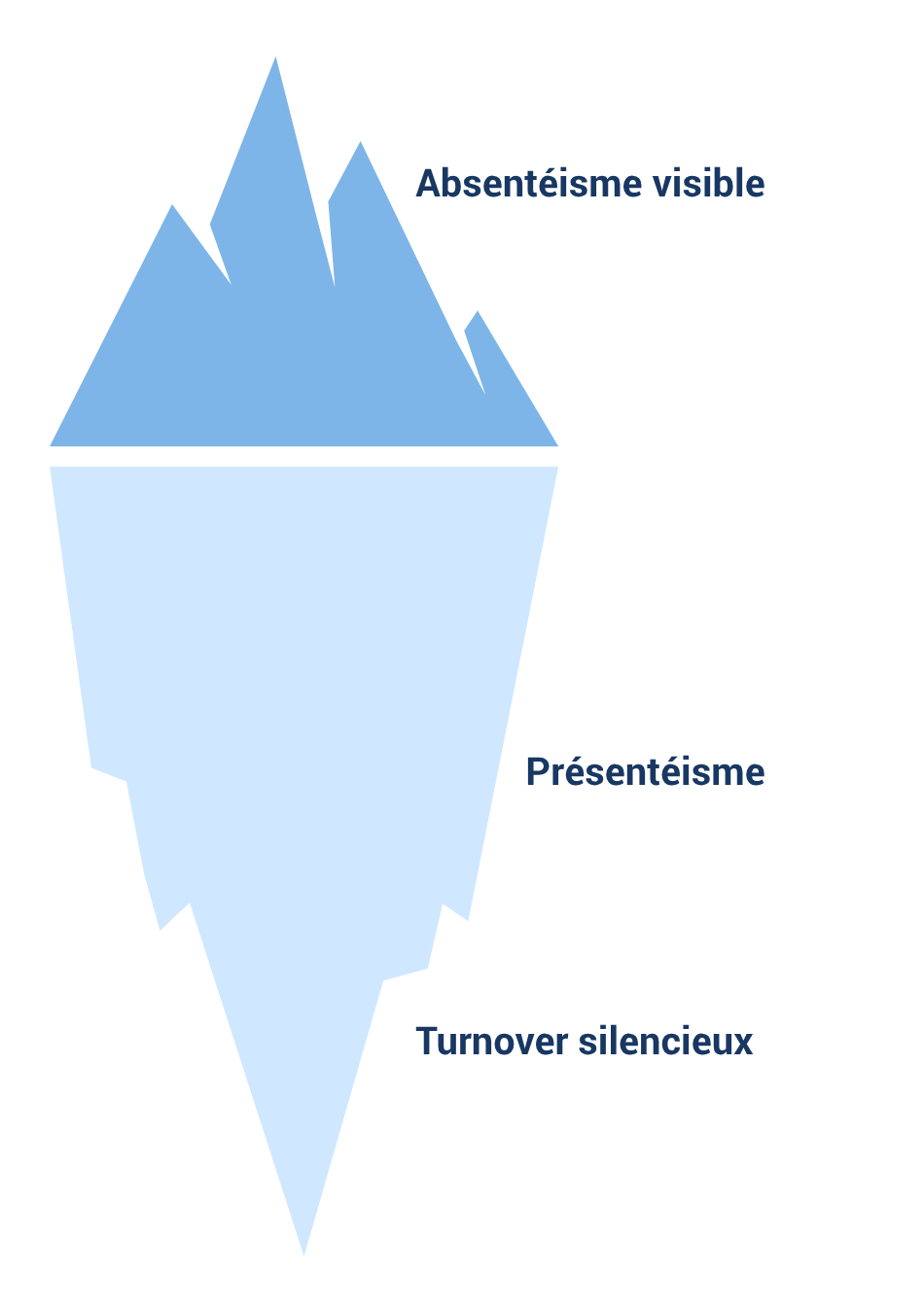
Visible absenteeism
An employee who is a caregiver spends an average of 9.8 hours per week caring for a loved one—10.6 hours for women and 9 hours for men (source: Occurrence / La Mutuelle Générale Barometer, 2023). This is the equivalent of one and a half extra days of work each week, outside of regular office hours.
When this burden becomes incompatible with a full-time job, employees make a choice: 39% of caregivers report a negative impact on their work—adjustments to their schedule (17%), reduced working hours (12%), or leaving their job (10%) (source: Ipsos-Macif survey, 2020).
Presenteeism — the tip of the iceberg
57% of employees who are caregivers say they are struggling. But 75% of them do not tell their managers about their situation, for fear of being stigmatized or held back in their careers (source: France Travail, 2024).
The result: they come to work, but their mental focus is partially elsewhere. They take calls from their desks to manage medical appointments.
They leave early on Fridays and arrive late on Mondays. They can’t cope, until they reach a breaking point.
Silent turnover
One-third of employees who are caregivers report working longer hours to compensate for a decline in productivity they themselves feel (source: OCIRP, 2023). Fewer than 2% have their work schedules adjusted or are granted special leave. When the strain becomes unbearable, some leave the company—without ever mentioning their caregiving responsibilities as a reason during their exit interview.
5 subtle signs to watch for in your HR data
A checklist that can be implemented immediately, without any new tools:
- Increase in sick leave lasting 1 to 3 days among people aged 35–55
- Requests for schedule adjustments without a specific reason
- Decline in performance detected during the annual review, with no work-related cause
- Unexplained turnover among experienced employees
- A usually dedicated manager gradually losing interest
Why this trend is set to worsen
An Inevitable Demographic Trend
By 2030, one in four employees will be a caregiver (source: France Travail, 2024). The French population aged 75 and older will rise from 6.5 million today to 8.5 million in 2030 (source: INSEE). Companies that have not established a support system by then will be reacting rather than taking preventive action.
A strengthening legal framework
Mandatory negotiations on QWTC (Quality of Life and Working Conditions) are gradually incorporating caregiving into the scope of psychosocial risks to be documented. Several industry sectors have begun to include specific provisions in their sector-wide agreements.
What Autonomia Changes for Your Employees Who Are Caregivers
Identifying caregiving situations within your company is the first step. Addressing them thoroughly is another. Autonomia offers a turnkey solution: a dedicated advisor—a social worker, social and family economics counselor, or nurse coordinator—contacts every employee who is a caregiver and requests assistance within 48 hours, in complete confidentiality. A 7-dimensional assessment, a personalized action plan, coordination of home care providers, and activation of financial assistance (APA, ARDH, MaPrimeAdapt’, CESU). On average, 16 days of sick leave are avoided per supported caregiver, and an aggregated, anonymized CSR report is provided to document the impact to the executive committee.
How many employees in my company are caregivers?
About 1 in 5 employees is currently a caregiver—that is, 20% of your workforce. In a company with 500 employees, that represents about 100 people, the vast majority of whom have never mentioned this situation to their manager. By 2030, this ratio will rise to 1 in 4 (source: France Travail, 2024; DREES, 2023).
How can I identify absenteeism related to caregiving in my dashboards?
Not directly—and that is precisely the problem. 75% of employees who are caregivers do not disclose their situation to their employer (source: France Travail, 2024). Absenteeism related to caregiving is hidden behind generic reasons. A targeted assessment, based on demographic and behavioral criteria (age, tenure, the subtle signs listed above), makes it possible to estimate the true extent of the problem without compromising confidentiality.
What are the main hidden factors contributing to absenteeism in the workplace in 2026?
Three underestimated factors will dominate in 2026: family caregiving (51% of employees who took sick leave in 2024 were caregivers—source: Malakoff Humanis 2025), the mental strain of parenting (particularly for single parents), and musculoskeletal disorders linked to working from home without proper equipment. Caregiving is the least visible of these, as 75% of affected employees do not disclose their situation to their employer.
What is the average annual cost to my company of an unidentified employee who provides assistance?
Between €4,500 per year (average cost of absenteeism — Malakoff Humanis 2024) and €7,240 per year when presenteeism, estimated at €2,740 per year, is included (Malakoff Humanis 2024). For a company with 500 employees and 100 statistically active caregivers, the total unidentified financial impact on payroll ranges from €290,000 to €450,000 per year.
What is the actual cost of a support staff member to the company?
An absent employee costs their employer an average of €4,500 per year, of which 20% are direct costs (continued pay, social security contributions) and 80% are indirect costs—replacement, reorganization, and loss of skills (source: Malakoff Humanis 2024). Presenteeism represents an estimated additional cost of €2,740 per affected employee per year.
Is caregiving an HR issue or a medical one?
Both, but the HR approach is the most effective. An employee struggling with burnout generally does not consult the occupational physician to discuss their situation—they handle it on their own until they reach the point of exhaustion.
It is the manager or the HR director who can create the conditions for the issue to be addressed: through an explicit policy, accommodations that are accessible without stigma, and a dedicated point of contact.
Where should I start if I want to take action on this issue at my company?
Three initial steps that don’t require a large budget: mapping exposure (demographic profiles, absenteeism data by age group), raising managers’ awareness of early warning signs, and setting up a feedback mechanism. The implementation of a structured program and its ROI are detailed in our comprehensive guide—ROI of the Employee Caregiver Program.

Sources
- Malakoff Humanis, 2025 Absenteeism Barometer
- Malakoff Humanis, Study on the Costs of Absenteeism and Presenteeism, 2024
- WTW, 2025 Absenteeism Barometer (430,000 employees analyzed)
- APICIL / JLO Group, Absenteeism Observatory 2025
- France Travail, 2024 Study on Family Caregivers
- DREES, Studies and Results No. 1255, February 2023 (drees.solidarites-sante.gouv.fr)
- Occurrence / La Mutuelle Générale Survey, 2023
- OCIRP, 2023 Caregiver Barometer
- Ipsos-Macif Survey, 2020
- INSEE, 2030 Population Projections