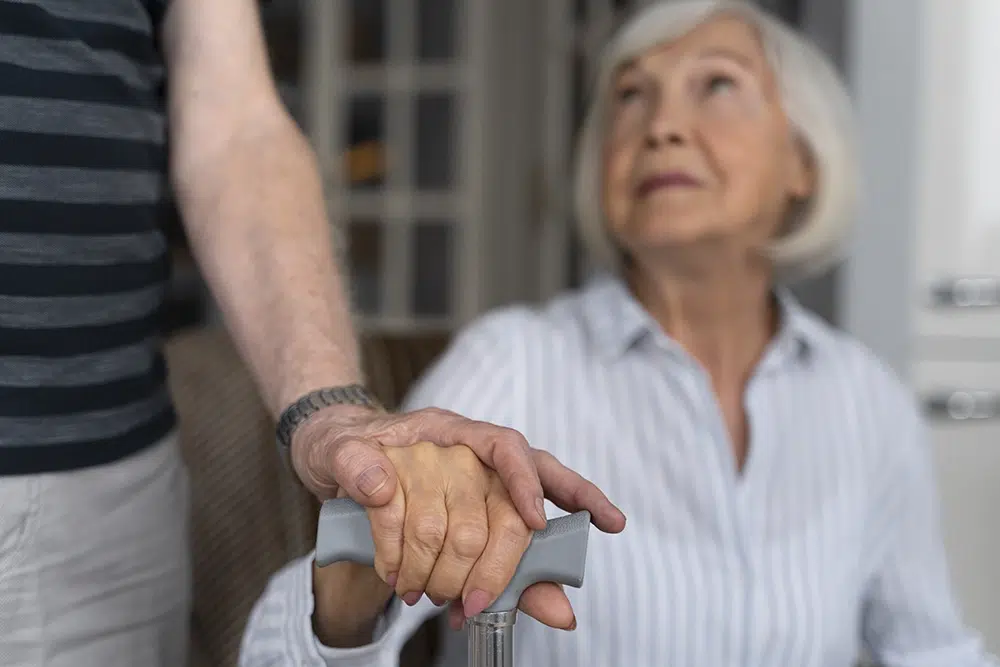
What if your parent’s refusal wasn’t an obstacle to be overcome, but a message to be deciphered?
Anyone who finds themselves caring for a parent quickly encounters resistance. Whether it’s simple reluctance or outright refusal, this opposition is an almost universal part of the caregiving relationship. Yet this “no” rarely makes no sense. Behind the closed-off attitude often lies a cry to preserve a threatened identity. Understanding this refusal means transforming a power struggle into a dialogue based on trust.
Denial or impaired judgment: the presumed causes
When faced with rejection, we tend to label the behavior in order to better deal with it. We often cite two main causes, but these can sometimes be oversimplified.
Denial of loss: It is assumed that the person refuses to admit their limitations. In reality, they are defending their social role and self-image. Accepting help means acknowledging the end of a certain way of life.
Cognitive impairment: The refusal is attributed to a condition (such as Alzheimer’s) that impairs judgment. While the disease may alter perception, it does not take away the person’s sense of feeling. What the person feels is their truth, and no one can tell them that their feeling is “wrong.”
What we observe | The traditional interpretation | The likely message |
Head-on collision | "He/She is throwing a tantrum" | "I want to remain in control of my own home." |
Deliberate neglect | "It's the illness speaking." | "This help reminds me too much of how vulnerable I am." |
Aggression | "Behavioral Disorder" | "I feel like my privacy is being invaded." |
Negotiation | "He/She doesn't realize" | "I'm looking for a compromise that will allow me to maintain my dignity." |
Behind the refusal lies the weight of our prejudices
We often view old age as a general decline. This assumption leads us, unconsciously, to dismiss the words of the elderly. As soon as an elderly person refuses, we suspect dementia.
However, hearing a refusal does not necessarily mean agreeing to it. Sometimes, for safety reasons, it is impossible to comply with the parent’s wishes. Nevertheless, acknowledging that this refusal has meaning changes everything. Even if the refusal is disproportionate to the physical risk (fall, malnutrition), it is perfectly in line with what the person is feeling in that moment. To deny that feeling is to deny the person themselves.
Change your approach to break the deadlock
Refusal becomes problematic when it clashes with our own anxieties as caregivers or with rigid administrative procedures. To move forward, we sometimes need to step back from the immediate crisis.
- Accept rather than correct: Rejection is a form of communication. Before trying to convince someone, acknowledge their feelings: “I understand that it bothers you to see a stranger walk into your kitchen.”
- The third-party strategy: The refusal is often directed at the child because accepting their help reverses the parent-child roles. Involving a professional (occupational therapist, doctor, Autonomia counselor) helps depersonalize the conflict.
- The Care Recipient’s Sense of Time: While the caregiver wants an immediate solution, the care recipient needs time to adjust. Moving from full-time care to “occasional assistance for comfort” often makes the transition easier.
Checklist — How to Respond to the Next Outage?
- Identify the underlying need: Is it a need for control? For privacy? For financial security?
- Acknowledge the validity of the feeling: Never say, “That’s not true—you need it.” Instead, say, “I can see that this is weighing on you.”
- Address the emotional aspect: Ask a third party to present the technical proposal.
- Offer “trials”: Don’t mention a permanent commitment; instead, refer to a 15-day trial.
- Reflecting on one’s own fears: Am I the one who’s afraid he’ll fall, or is he the one facing an immediate life-threatening risk?

FAQ
What should you do when refusing puts the person in danger?
It’s the dilemma of safety versus freedom. If the danger isn’t life-threatening, it’s sometimes necessary to accept a calculated risk to preserve the parent’s relationship and mental health. Negotiating a “safety compromise” is often more effective than imposing one.
Why does my parent accept help from the nurse but not from me?
The caregiver has a practical role. The child has an emotional role. Accepting that your child is washing you or helping you eat is a deeply painful psychological process. It’s not directed at you; it’s a way for them to protect themselves.
Is it denial if he says he can still climb the stairs even though he's falling?
It’s a strategy for preserving one’s identity. He doesn’t deny his decline; he denies the label of “dependent person.” Focus on presenting the technical aid (stairlift) as a “modern” comfort feature rather than a medical device.
Is it necessary to lie in order to get help?
"White lies" are a complex issue. Generally, omitting certain details or rephrasing them (such as saying, "A lady is coming to do a deep clean" rather than "A home health aide because you're losing your independence") is preferable to outright deception, which would break trust.
Are you feeling exhausted by your loved one’s repeated refusals?
Don’t face this situation alone. Autonomia offers awareness-raising modules and personalized support to help families reestablish communication. Talk to your HR department.