
Transforming the family home so it remains a peaceful place to live: a guide to technical and financial solutions in 2026.
For 90% of seniors, aging in place is a top priority. However, a family home, designed for an active lifestyle, can become a barrier to independence as one gets older. Adapting a home isn’t just about installing a grab bar; it’s a comprehensive project that requires planning ahead. Between new government assistance programs like MaPrimeAdapt’ and cutting-edge technical solutions, here’s how to transform your parents’ home while staying within your budget.
Plan ahead to avoid being caught off guard
Most home modifications are carried out on an emergency basis, often following a fall or hospitalization. However, taking action early on allows you to choose more aesthetically pleasing and better-integrated solutions—and, most importantly, to take advantage of financial assistance before the situation becomes critical.
The three pillars of successful adaptation:
- Accessibility: Being able to enter and move around without obstruction (door thresholds, ramps).
- Safety: Preventing accidents in bathrooms and on stairs.
- User-friendly design: Simplifying everyday tasks (motorization, home automation).
Overview of Financial Assistance in 2026
The landscape of financial assistance has been simplified to make it easier for families to navigate. There are four main ways to finance independent living at home. Understanding them well can help families minimize their out-of-pocket costs.
Device | Organization | What for? | Who is it for? |
MaPrimeAdapt’ | ANAH | Renovations (shower, stairlift, handrails). | Aged 70 or older, or in care level 1–6 (low income). |
PCH | MDPH | Accessibility modifications (up to €10,000). | Disability occurring before age 60. |
Tax Credit (50%) | Government (Tax) | Household help (housekeeping, meal preparation, gardening). | All seniors (regardless of income). |
APA | Department | Manpower and small, lightweight equipment. | Seniors aged 60 and older (GIR 1–4). |
A step-by-step guide: How do you get the project off the ground?
1. The autonomy assessment
Before contacting a contractor, the essential first step is to consult an occupational therapist. This healthcare professional assesses your parent’s abilities in their actual living environment. They don’t just suggest installing a shower; they evaluate how your parent moves around, sits down, and stands up.
Did you know? In 2026, to qualify for MaPrimeAdapt’, assistance from a Project Management Consultant (AMO) will be required to validate the project’s feasibility.
2. Choosing the equipment
- The Bathroom: Replacing the bathtub with a walk-in shower remains the top renovation choice. In 2026, the preference is for extra-shallow shower pans and “half-height” shower enclosures, which allow a caregiver to assist with bathing without getting wet.
- Stairs: If the home has a second floor, a stairlift is the quickest solution. For tighter budgets or narrow spaces, installing a second handrail can already make moving around safer.
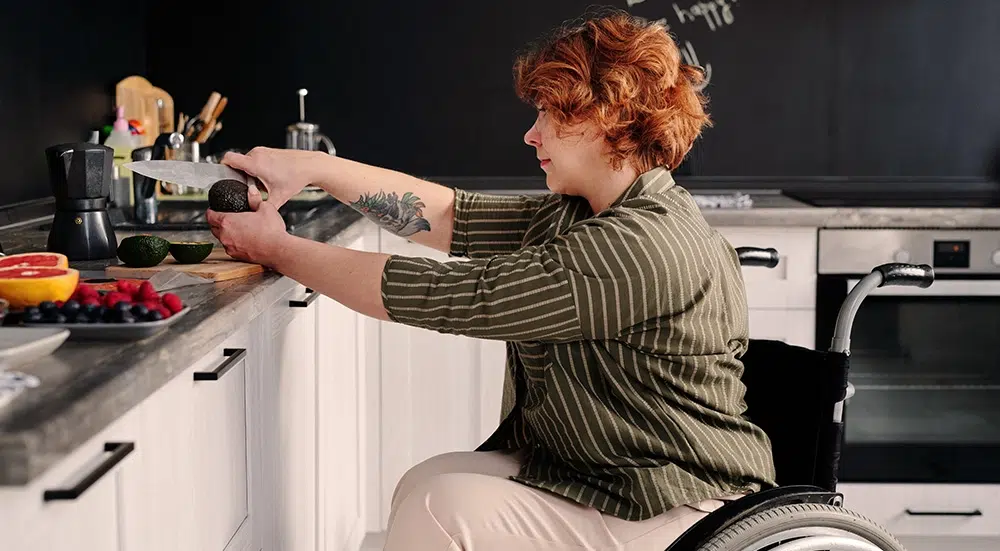
- The kitchen: We recommend adjustable-height countertops and sliding drawers to prevent your parent from having to bend down or step up onto a stool.
3. Preparing the funding application
Once you have received quotes from RGE-certified (Reconnu Garant de l’Environnement) have been obtained, the application is submitted electronically. MaPrimeAdapt’ can cover up to €15,400 (70% of €22,000 excluding tax) for the lowest-income households. For middle-income households, the tax credit remains an option for certain specific equipment.
Checklist — Key Steps in Your Project
- Assessment: Consult an occupational therapist to determine actual needs.
- Eligibility: Check your parents' taxable income against the ANAH 2026 income guidelines.
- AMO: Contact a certified advisor to apply for MaPrimeAdapt’.
- Get a quote: Get 2 to 3 quotes from RGE-certified professionals specializing in in-home care.
- Timeline: Allow 3 to 5 months from the initial assessment to the completion of the work.
FAQ
Can MaPrimeAdapt' be combined with the APA?
Yes. MaPrimeAdapt’ covers the costs of “major” structural renovations (such as a shower or a stairlift), while the APA can cover the costs of personal care assistance and standard small technical equipment.
My parent is a tenant. Can they do home improvements?
Yes, but the landlord’s written consent is required. The landlord cannot object if the tenant is paying for the work and it is intended to improve accessibility, but the landlord must be officially notified by certified mail.
What is an RGE-certified contractor, and why is it mandatory?
The RGE certification ensures that the contractor has been trained in accessibility and energy-efficiency renovation standards. This is a prerequisite for receiving government subsidies in 2026.
Is there any financial assistance available for outdoor renovations (access ramps)?
Yes, MaPrimeAdapt’ also covers outdoor modifications that facilitate access to the home (pathways, ramps, outdoor lighting).
Are you an employee?
Your company may be able to help you cover the costs or arrange for this assessment. Autonomia works with networks of occupational therapists and certified contractors to make this process easier for you. Talk to your HR department.